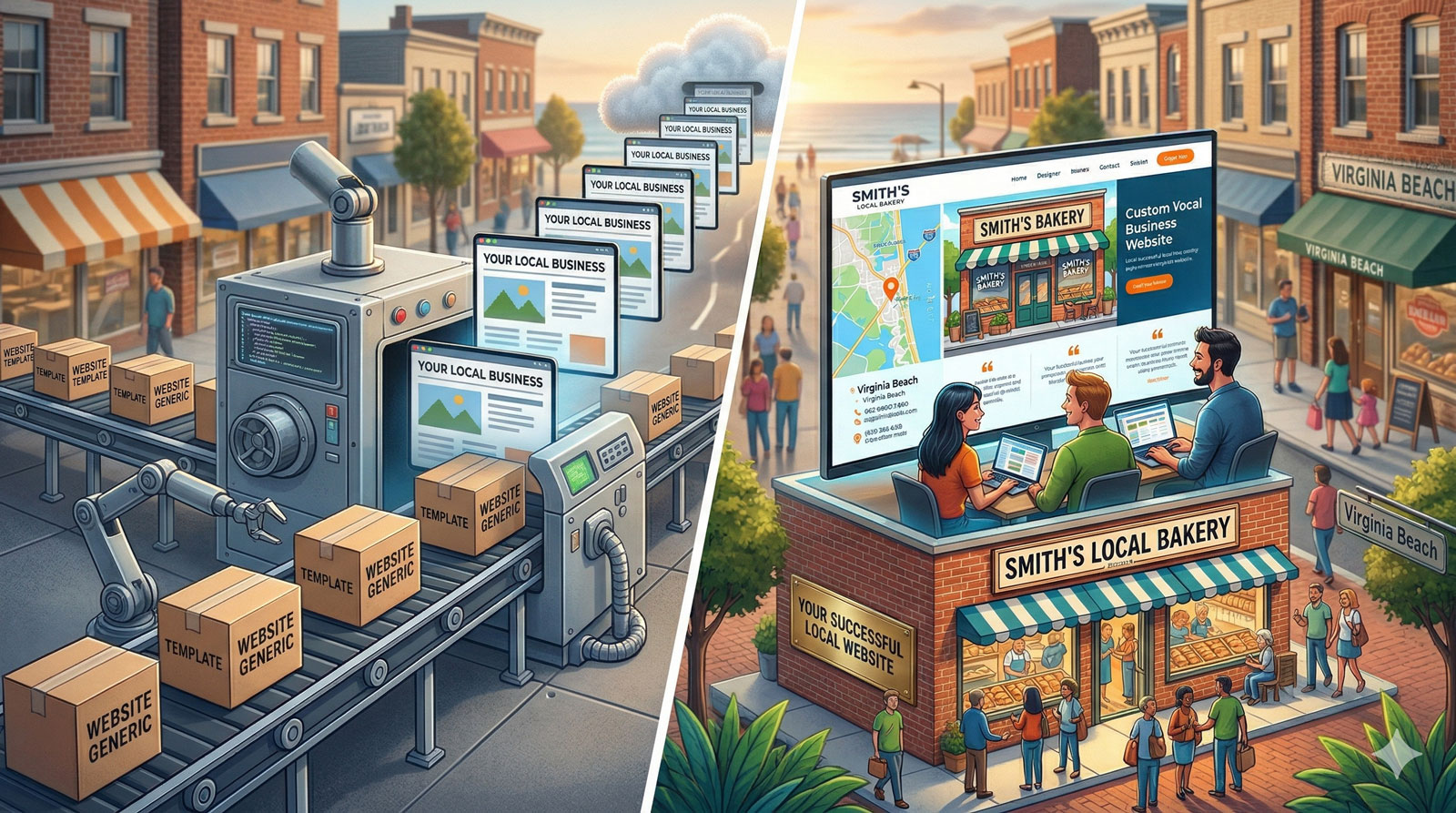
Why Generic Website Solutions Fall Short for Local and Regional Businesses
Rev Marketing 2U Marketing Intelligence Series
How Specialized Marketing Platforms Win More Customers in 2026 and Beyond
Title: Founder | Rev Marketing 2U and Rev Connect 360
Year: 2026
Section One
The Problem Most Business Owners Never See Coming
Let’s start with a scenario that plays out in local businesses across the country every single week. A homeowner Googles “plumber near me” on a Tuesday evening after a pipe starts leaking. A parent searches for “childcare center near me” during a lunch break. A dog owner types “veterinarian open now” from a parking lot. A couple looks up “winery tasting near me” on a Saturday morning. Several results appear. They tap the first one, glance at the site for about eight seconds, and leave. The second loads slowly, so they back out before it finishes. They tap the third, and something about it just feels different — it’s clean, it answers their questions before they even know what to ask, and within thirty seconds they’re filling out a form or clicking to call.
The first two businesses had qualified staff. They had services worth promoting. But their websites lost the moment before it ever had a chance to become a lead.
This is the quiet, invisible problem facing thousands of local and regional business owners right now. It doesn’t matter whether you run a dental practice or an HVAC company, a family law firm or a neighborhood salon, a craft brewery or a fitness studio, a restaurant or an auto repair shop. The platform problem is the same across every industry: the website solution they’re relying on to represent them online was never actually built for the job of winning new customers. It was built to manage existing ones — or it was assembled quickly just to check a box.
CRM-based and template website solutions became popular for understandable reasons. They promise simplicity: one login, one dashboard, one vendor relationship. You can process billing, manage appointments, communicate with clients, and “check off” the website box all in the same place. For a busy business owner wearing six hats before noon, that pitch is genuinely appealing.
But here is what the pitch leaves out: the website component of these platforms is, almost universally, an afterthought. It was bolted onto a system built around operations management. The core product — the thing their engineers optimize and stake their reputation on — is the back-end software. The website is a feature. And in 2026, running your marketing operation on a feature instead of a dedicated marketing platform is the difference between thriving and wondering why your customer pipeline keeps stalling.
The evidence shows up in Google Analytics dashboards that business owners rarely look at closely enough. Bounce rates over seventy percent. Average time-on-site under twenty seconds. Mobile load times stretching past four or five seconds. These aren’t just bad numbers — they represent real customers who clicked, formed an impression in under a second, and left to find someone else. Google’s own research confirms that as load time increases from one second to three seconds, the probability of a visitor bouncing increases by 32 percent. Push it to five seconds and that bounce rate can exceed 90 percent. Your platform vendor probably isn’t telling you any of this. Why would they? Their revenue comes from your software subscription, not from your new customer acquisition rate.
“Most business owners think they have a marketing problem. What they actually have is a platform problem.”
Increase in bounce rate when a page takes 3 seconds to load instead of 1. At 5 seconds, bounce rates can exceed 90%. Whether you’re a dental office, a restaurant, or a roofing company, slow load times are quietly costing you leads every day. (Google Research)
Section Two
Built to Manage, Not Built to Persuade
There’s a fundamental distinction in software design that most business owners have never had a reason to think about, but it explains nearly everything about why generic and CRM-templated websites underperform: management software and marketing software have completely different jobs.
Management software serves people who already trust you. A patient logging into a dental portal to confirm an appointment, a client checking the status of their legal case, a gym member managing their membership, a homeowner reviewing a service invoice — these people are already committed. The software just needs to work. Speed matters, but the emotional stakes are low. The relationship is already established.
Marketing software, on the other hand, has to earn trust from strangers. It has to meet someone who has never heard of your business, knows nothing about your team, and is probably comparing you to two or three other options open in other browser tabs — and it has to convert that person from curious to committed, often in under a minute. That’s not a technical challenge. That’s a persuasion challenge, and it requires an entirely different set of tools, principles, and priorities.
When you run your marketing on a generic or CRM-templated website, you’re asking a management system to do a persuasion job. And it shows. The dentist whose website was built by their practice management software vendor. The HVAC company running on a home services CRM template. The family law firm using a legal software add-on for their web presence. The winery or brewery whose site was thrown together to get online quickly. The salon using a booking platform’s built-in website feature. The auto repair shop relying on an industry directory’s template. In every case, the templates are generic by design — they have to work for the pediatric dental office in Phoenix and the general contractor in suburban Ohio and the Italian restaurant in Miami. There’s no way to build real specificity or authority into a template like that. The calls to action are buried or unclear. The content structure prioritizes information over emotion. And the overall experience rarely builds the kind of trust that causes a first-time visitor to stop browsing and start booking.
“Your website isn’t just informing people. It’s convincing them. And if it can’t do that quickly, the opportunity disappears before you ever know it existed.”
of users judge a business’s credibility based primarily on website design, before reading a single word of content. This applies equally to a law firm, a salon, a brewery, or a home services company. First impressions are made in milliseconds. (Stanford Web Credibility Research)
Psychology researchers call the pattern “thin-slice decision-making” — the human brain’s ability to form strong, lasting impressions from very small slices of experience. A study out of the University of Toronto found that people make aesthetic judgments about websites in as little as 50 milliseconds. That’s 0.05 seconds. The conscious mind hasn’t even registered the visit yet, and the gut has already decided whether this place feels credible.
Stanford’s Web Credibility Research Project reinforced this finding, showing that 75 percent of users admit to judging a company’s credibility based primarily on its website design. Not its reviews. Not its prices. Its design. Which means a law firm with genuinely skilled attorneys, a dental practice with the best technology in town, a restaurant with extraordinary food, a veterinary clinic with a deeply caring team, or a winery producing award-winning bottles can lose a prospective customer’s trust before a single word is read — simply because the website feels dated, cluttered, or generic. There truly is a difference between a website built by a website company and one built by a marketing and brand agency.
Generic templates, by their very nature, produce dated, cluttered, and generic websites. That’s not a criticism of the companies that build them. It’s simply the mathematical reality of trying to design a one-size-fits-all marketing surface for thousands of different clients across dozens of different industries. You cannot build a high-converting, trust-establishing, brand-specific marketing presence on a template built for everyone. It’s not possible.
Section Three
The 2026 Search Landscape Has Changed the Stakes
Even if generic and CRM-templated websites performed adequately a few years ago — and many business owners got by just fine on them — the search environment has shifted in ways that make their structural limitations far more consequential today.
Search engines have always rewarded quality, but the definition of quality has grown far more sophisticated. In 2026, Google evaluates your website across dozens of technical and experiential signals: Core Web Vitals (which measure real-world loading speed, interactivity, and visual stability), mobile usability, content depth and relevance, structured data, and E-E-A-T signals (Experience, Expertise, Authoritativeness, and Trustworthiness). A slow, generic, poorly-structured website doesn’t just convert poorly — it ranks poorly. Which means fewer people ever find it in the first place.
But the more dramatic shift isn’t just in how Google ranks websites. It’s in how people search. Voice search has become mainstream. AI-powered assistants like Google’s AI Overviews, Apple’s Siri, and others are now fielding search queries and returning synthesized answers — not just lists of links. When a homeowner asks Siri “What’s the best HVAC company near me?” or a family asks “Find a pediatric dentist nearby” or someone searches “Best vineyard for a private event in this area,” the answer they receive is being assembled by an AI model that has crawled and evaluated the web for signals of authority, clarity, and trustworthiness.
This is why the concept of Answer Engine Optimization — AEO — has emerged alongside traditional SEO. It’s not enough to rank well in a Google search results page anymore. Your content needs to be structured and authoritative enough that AI systems choose to surface your business as a credible answer to a direct question. Generic and template-built websites, with their thin content, cookie-cutter structure, and minimal authority signals, are essentially invisible to these AI-driven discovery systems. Whether you’re a fitness studio competing with national gym chains or a local auto repair shop competing with franchise service centers, this invisibility costs you real customers every week.
“It’s not enough to show up in search results anymore. Your website needs to be structured so that AI systems recognize you as the authoritative answer — and choose to recommend you.”
Social proof has also become far more decisive in the purchase decision process. According to BrightLocal’s annual Consumer Review Survey, 98 percent of consumers read online reviews for local businesses before making a decision. For a family choosing a childcare center, a homeowner choosing a roofing contractor, a pet owner choosing a veterinarian, or a couple choosing a restaurant for a special occasion — the emotional stakes are high enough that they’ll look for every available signal that they’re making the right choice. Testimonials from real customers, photos of real work, video content, and prominently displayed review scores are not nice extras anymore. They are table stakes.
Most generic and CRM-templated websites offer little meaningful ability to integrate authentic social proof in a compelling, conversion-optimized way. You might be able to paste a Google reviews widget somewhere on the page, but the overall experience — the trust architecture of the website as a whole — isn’t designed around building confidence in a first-time visitor. It’s designed around giving existing customers a place to log in.
The mobile dimension compounds this further. For local service searches, users are often making decisions in the moment — on a phone, while multitasking, and with alternatives one tap away. A website that loads slowly or displays awkwardly on mobile isn’t just a minor inconvenience. It is, functionally, a closed door.
of consumers read online reviews for local businesses before making a decision. Across every industry — from dental practices to restaurants to auto repair shops — your review presence and on-site social proof directly determine whether new customers ever contact you.
Section Four
The Launch System Analogy: Why Specialized Systems Win
During NASA’s Artemis mission coverage — the first crewed lunar mission in more than fifty years — one thing struck me while watching the broadcast. The sheer number of specialized systems involved in getting that crew safely to the moon and back. There was the Space Launch System itself, one of the most powerful rockets ever built. There was the Orion spacecraft, engineered specifically for deep-space human habitation. There was mission control, running on purpose-built software. There were communication relay systems, life support systems, trajectory tracking systems — each one a marvel of engineering in its own right, each one designed for a specific and critical function.
NASA didn’t launch that mission on a commercial aircraft that had been modified to approximate a spacecraft. A commercial jet is a spectacular piece of engineering. It’s reliable, comfortable, and extraordinarily good at doing what it was designed to do. But no amount of modification would get it to the moon. It wasn’t built for that mission.
This is exactly the distinction between a generic or CRM-templated website and a true marketing platform. Your operations software — your practice management system, your scheduling platform, your booking tool, your industry-specific CRM — may be excellent at what it was built for. These are genuinely valuable functions, and we’re not suggesting you abandon them. But asking that software’s templated website to lead your customer acquisition effort is like asking that commercial jet to reach the moon. It might get off the ground. It will not get you where you need to go.
“A commercial jet is brilliant engineering. It just will never reach the moon. The same is true of CRM websites — they may function, but they’re not built for the mission of winning new customers.”
The alternative is what Rev Marketing 2U has spent years building: a coordinated, specialized system where every component has a specific job, every component is optimized for that job, and all components work together as one seamless mission. It’s not one tool trying to do everything. It’s multiple purpose-built tools doing exactly what they’re designed to do, perfectly synchronized. And it works for the dental practice as well as it works for the brewery, the law firm, the fitness center, the salon, and the roofing company — because the underlying mission is always the same: turn strangers into customers and customers into advocates.
Section Five
The Rev Marketing 2U Growth System: Four Components, One Mission
When a business launches with Rev Marketing 2U, they’re not simply swapping out a website. They’re deploying a coordinated growth infrastructure — four specialized components, each one engineered for a specific phase of the customer acquisition journey, all working together to fill your pipeline and keep it full.
What does that mean in practice? It means your site loads fast — fast enough that it doesn’t lose visitors before they see anything. It means the content is structured so that search engines and AI systems can understand what your business offers, who it’s for, and why it’s the right choice. It means calls to action are clear, prominent, and psychologically calibrated to reduce friction at the moment of decision. And it means the design itself communicates credibility — not through flashy effects, but through the kind of confident, clean, professional presentation that tells a first-time visitor: this business knows what it’s doing.
Rev Publish solves this through a systematic, ongoing content strategy designed specifically for your industry. It ensures your online presence continues to grow, your authority signals continue to strengthen, and your visibility continues to expand — month after month, without requiring a business owner to also become a content marketer.
It gives business owners visibility into their pipeline, automates intelligent follow-up sequences, and provides the performance data needed to understand what’s working and what needs adjustment.
For most business owners — whether they’re a dentist running a full patient schedule, an HVAC technician on a job site, a restaurant owner managing a dinner rush, or a salon owner with a full book — responding to every lead within five minutes, around the clock, seven days a week, is simply not realistic. And so leads wait. And then they find someone else.
Sentinel is the AI operator that makes the five-minute response a reality regardless of when a lead comes in. It handles inbound calls, text inquiries, chat conversations, and booking requests — intelligently, naturally, and immediately. It doesn’t replace the human relationship that’s at the heart of what every great business offers. It ensures that the human relationship gets the chance to start.
Businesses that respond to inbound leads within 5 minutes are up to 9 times more likely to convert them than those that wait even an hour. Sentinel makes instant response possible 24 hours a day, 7 days a week — for every industry, every time zone, every inquiry.
Section Six
What Happens When the System Changes
The shift that businesses experience when they move from a generic or CRM-templated website to a purpose-built marketing platform isn’t subtle. It tends to be visible relatively quickly, and it shows up in metrics that actually matter: more organic search traffic, more time-on-site, higher lead conversion rates, and ultimately, more customers.
The reason is straightforward even if the execution isn’t: friction drives people away. Every unnecessary second of load time, every confusing navigation choice, every unclear call to action — each one is a leak in the pipeline. Some visitors will push through anyway. But many won’t. And in a world where alternatives are one tap away, that represents a meaningful percentage of the customers who could have chosen you.
When friction is removed — when the website loads immediately, the message is clear, the social proof is compelling, and the next step is obvious — visitor behavior changes. People stay longer. They explore more deeply. They form trust more quickly. And they take action at a higher rate. The industry benchmark for website conversion rates hovers around two to three percent. Well-optimized marketing platforms consistently push that to four, six, eight percent or higher, depending on traffic quality and business positioning.
The compounding effect of that improvement is significant. If your website currently generates twenty leads per month on a three percent conversion rate and a platform upgrade pushes that to six percent, you’ve doubled your leads without spending a dollar more on advertising. You’ve simply stopped losing the people who were already finding you.
“The biggest problem with an underperforming website isn’t that it fails loudly. It’s that it fails quietly — one lost opportunity at a time, week after week, in ways you never see.”
Section Seven
A Note on Cost and the Ecosystem Question
We’d be leaving something important on the table if we didn’t address the economics directly, because cost is often the reason business owners stick with generic website solutions even when they suspect something better exists.
Platform vendors keep their website offerings inexpensive — or bundle them into the overall subscription — for a deliberate reason. The website isn’t where they make their money. Their revenue comes from your billing processing, your student or patient database, your scheduling tool, and their monthly SaaS fees. The website is essentially a loss-leader designed to keep you inside their ecosystem.
This creates a dynamic worth examining honestly. You may be saving a few hundred dollars a month on your website by staying with your existing platform. But if that website is converting at half the rate of a purpose-built marketing platform, what is that actually costing you? A dental practice that loses five new patients a year to a slow, unconvincing website. A roofing company that misses three large jobs because their site didn’t inspire confidence. A restaurant that loses a hundred reservation inquiries per month because their mobile experience is broken. The math stops looking like a savings in any meaningful sense.
We also want to be clear about something: Rev Marketing 2U is not suggesting you abandon your operations software. If your scheduling system works, your billing platform runs smoothly, and your back-end tools help your business operate efficiently — keep them. What we’re suggesting is that you stop asking them to be your marketing platform. Let them do what they do well, and build your customer acquisition operation on a system that was actually designed for that mission.
Section Eight
The Bottom Line: Manage or Grow
Here is the clearest way to think about everything this paper has covered: operations systems manage relationships. Marketing platforms build them.
A generic or CRM-templated website will keep the lights on. It will process bookings, store contact information, and check the “website” box on your business checklist. For a business that’s already at capacity and simply needs to maintain its customer base, it might even be adequate. But for a business that wants to grow — that wants to attract new customers consistently, rank higher in local search, earn trust from people who’ve never heard of you, and convert more of the people who do find you — adequate is the enemy of progress.
The competitive landscape across local and regional business is intensifying. Customers in your market have options. They’re comparing your business to others on screens that take two seconds to switch between them. Your website is your first impression, your audition, and your sales floor all at once. In that environment, the platform you choose to build it on is not a minor operational decision. It’s a strategic one.
The businesses that are winning in 2026 — the dental practices with full schedules, the law firms with waitlists, the restaurants with reservations booked weeks out, the salons with loyal clientele growing every month, the breweries with tasting room traffic climbing — are not necessarily the ones with the most experienced staff or the most impressive facility, though those things matter. They’re the businesses that have figured out how to win online first. Because that’s where the decision happens now.
“Your operations software manages the customers you already have. Your marketing platform should be winning you the next one.”
The mission is clear. The tools exist. The question is whether you’re deploying the right ones.
Get business insights you’ll actually want to read
Rev Marketing’s “The Owner’s Playbook” gives business owners the latest news and tools they need to be successful.