Beyond the Launch: Why Your Business Needs More Than a Website
Rev Marketing 2U Marketing Intelligence Series
Beyond the Launch: Why Your Business Needs More Than a Website
Title: Founder | Rev Marketing 2U and Rev Connect 360
Year: 2026
Section One
The Rocket That Already Left the Pad
As this whitepaper goes to press on April 6, 2026, the world is watching something extraordinary unfold in real time. NASA’s Artemis II mission — carrying astronauts Reid Wiseman, Victor Glover, Christina Koch, and Jeremy Hansen aboard the Orion spacecraft — is completing its historic lunar flyby today. The four-person crew launched from Kennedy Space Center on April 1st, becoming the first humans to travel beyond low Earth orbit since Apollo 17 in 1972. And tonight, at approximately 6:47 p.m. Eastern Time, they will enter a phase unlike anything else in the mission.
As Orion swings around the far side of the Moon, mission control will lose all contact with the spacecraft for approximately forty minutes. The Moon itself will block every radio signal between Earth and the crew. No telemetry. No confirmation of systems. No communication in either direction. The crew and their vessel will be entirely on their own, guided only by the precision of what was built, programmed, and planned long before they ever left the ground. It is the most extraordinary forty minutes in human spaceflight since the Apollo era — and it is happening tonight.
In those forty minutes, the difference between success and failure won’t be thrust or fuel. It will be infrastructure. It will be the quality of the systems that were designed, tested, and optimized specifically for this mission — systems built not just to get airborne, but to navigate the unknown, sustain momentum through silence, and complete the mission even when no one can see what is happening.
Tonight’s silence will reveal whether the infrastructure was good enough. And for thousands of business owners across every industry — from dental practices and law firms to HVAC companies, restaurants, salons, auto repair shops, fitness studios, veterinary clinics, wineries, and childcare centers — there is a version of this same moment playing out in their digital presence right now. You launched. You have a website. Maybe you even have a CRM or some social media presence. But somewhere between liftoff and orbit, many businesses enter their own silent zone — where the phone isn’t ringing the way it should, leads aren’t converting, and no one seems to know exactly why. The launch felt successful. The mission, however, has stalled.
This whitepaper is about what separates businesses that orbit successfully — that sustain momentum, attract new customers, and build trust at scale — from those that got off the ground and drifted. And it starts with a fundamental truth that most business owners have never had anyone explain to them clearly: a website is not a marketing platform. And without a marketing platform, getting seen, getting trusted, and getting chosen is left almost entirely to chance.
“The mission will succeed or fall short on the strength of what was built before the launch. The same is true for your business’s digital presence.”
Minutes of complete communications blackout behind the Moon becomes a powerful analogy for the moments when businesses discover whether their digital infrastructure was truly built for the mission. (Artemis II analogy)
Section Two
What Most Business Owners Actually Have (And Don’t Know It)
Let’s be honest about the landscape. When a business owner says they have a website, what they usually mean falls into one of three categories. Either they built it themselves using a drag-and-drop platform, they had a family member or a friend “who’s good with computers” put it together, or they’re using the website feature included with their practice management system, CRM, or industry software.
All three of these approaches have the same thing in common: they were designed to look like a website. And on the surface, they often do. They have a logo, a few pages, some photos, a phone number, and maybe an inquiry form. To the business owner looking at it on their own desktop, it looks professional enough.
But looking good and performing well are two entirely different things. A spacecraft can look magnificent sitting on the launch pad. That’s not the same as being engineered to orbit. The same is true for websites and marketing platforms. The visual surface is just the beginning. What matters — what determines whether that site actually does anything for your business — is what’s under the hood: the architecture, the technical infrastructure, and the strategic intent behind every page, every word, and every call to action.
A marketing platform built by a brand and marketing agency is designed around a single mission: to attract strangers, earn their trust, and convert them into paying customers. This is as true for a roofing company as it is for a winery. As true for a veterinary clinic as it is for a fitness studio. It is not a tool for managing people who already know and trust you. It is a persuasion engine built for people who have never heard your name, are comparing you to several other businesses, and will make a lasting judgment about your credibility in under a second.
A DIY website, a friend’s template build, or a software vendor’s web feature cannot do this job. Not because the people who built them aren’t talented, but because that was never the goal. They didn’t know what they didn’t know. And in most cases, neither did the business owner who accepted the result.
“They don’t know what they don’t know. A website that looks polished to you may be completely invisible to the customers you’re trying to reach — and completely unconvincing to the ones who do find it.”
Common website paths business owners rely on: DIY builders, friend/family builds, or software-platform website features. None were designed first as true marketing platforms.
This is the invisible gap. You built something. It exists. But it isn’t working — not because your business isn’t good enough, but because the platform wasn’t built to work. The mission requires more than a launch. It requires a vessel specifically engineered for the journey ahead.
Section Three
Just Because You Build It Doesn’t Mean They’ll Come
Here is a belief that quietly sabotages more businesses than almost anything else: if I have a website, people will find me. It’s the Field of Dreams fallacy applied to digital marketing, and it is costing business owners real revenue every single month — whether they run a dental practice, a law firm, a restaurant, an HVAC company, a salon, or a brewery.
Even the most beautifully engineered spacecraft doesn’t drift into orbit on its own. Once the initial thrust has done its job, sustained propulsion systems take over. Without them, the craft loses momentum and falls back to Earth. A website is no different. The platform is the vehicle. But without a driving force behind it, it sits still in the vastness of the internet while the customers you want to serve scroll right past.
That driving force is called marketing, and in 2026 it comes in several forms — each with its own purpose, its own timeline, and its own role in a well-constructed growth strategy. The businesses that are winning right now aren’t doing one of these things. They’re doing several of them, in alignment with each other, and on a platform designed to amplify everything they put into it.
The first layer is what we call Answer Engine Optimization — or AEO. Most business owners are familiar with the concept of SEO, of ranking well in Google search results. But the search environment has shifted dramatically. AI-powered tools like Google’s AI Overviews, Apple’s Siri, and voice-based assistants are now answering search queries directly, without ever sending the user to a results page at all. When someone asks “What is the best HVAC company near me?” or “Find a family dentist accepting new patients” or “Where can I book a private wine tasting nearby?” the AI is making a recommendation based on which websites it has evaluated as authoritative, trustworthy, and clearly structured.
This is where AEO and strategically designed FAQ content become critical. A marketing platform built by Rev Marketing 2U is structured to answer the exact questions that prospective customers are asking — not just in ways that look good on a page, but in formats that AI systems can read, interpret, and surface as credible answers. Think of it like gravity: the right content structure creates a pull that draws customers toward your business even before they consciously begin their search.
“In today’s search environment, you’re not just trying to rank on Google — you’re trying to be the answer the AI chooses to give. That requires a completely different kind of platform.”
Businesses with strategically structured FAQ and AEO content are significantly more likely to be surfaced by AI-powered search assistants than those with generic or template-built websites — across industries from law firms to restaurants to home services.
Section Four
The Three Engines of Sustainable Growth
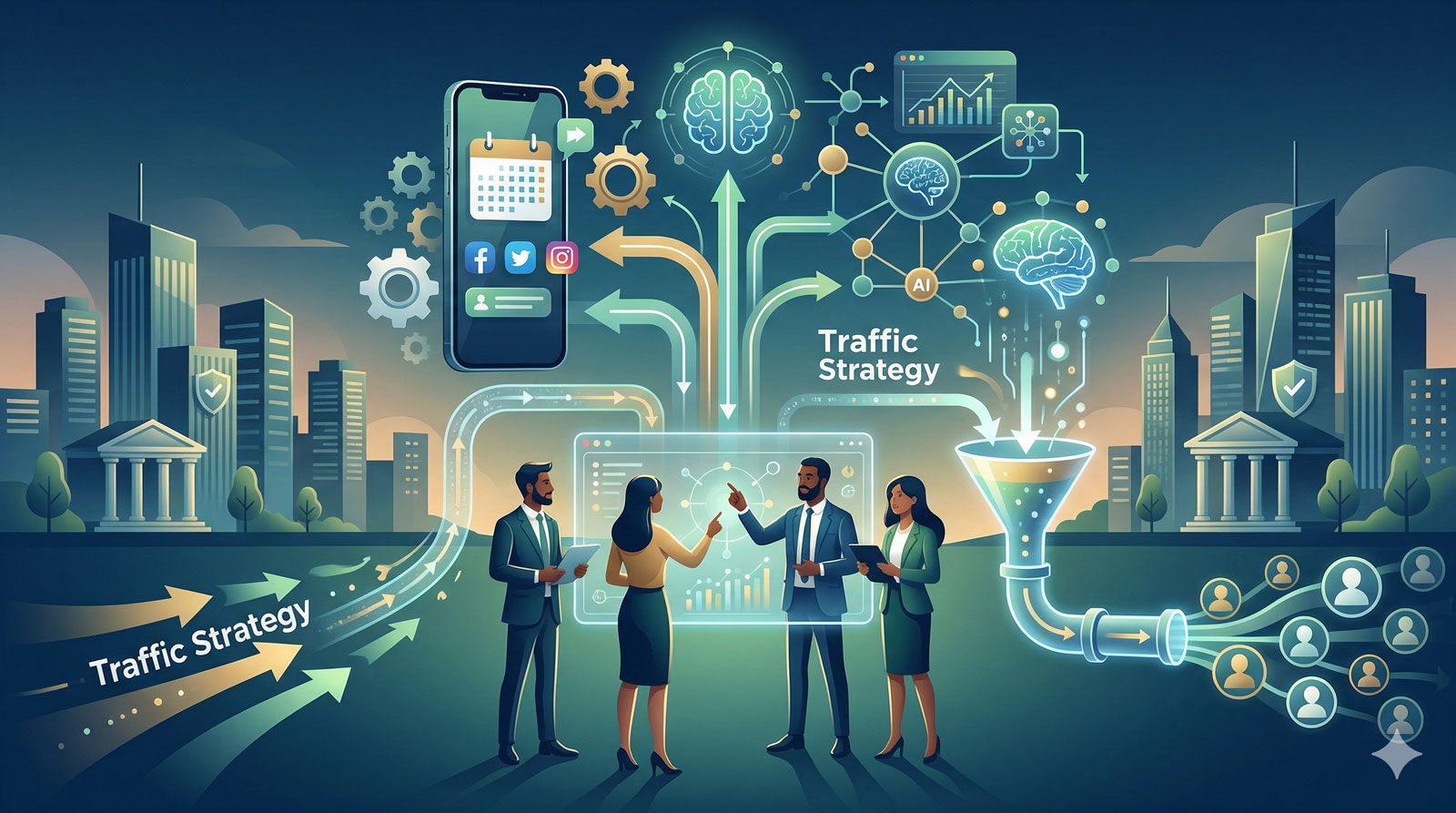
Once a business has a true marketing platform in place — one built on brand, mission, and conversion architecture — the next critical question is: how do we drive traffic to it? There are three primary engines that power sustained customer growth, and understanding how they work together is the difference between a business that occasionally gets leads and a business with a predictable pipeline.
The first engine is organic marketing, and it is the one most business owners underestimate most severely. Organic marketing is the slow burn — the work that doesn’t pay off immediately but compounds over time into something powerful and largely self-sustaining. At the center of organic marketing is content: blog articles that establish authority and feed the search algorithms, images and photos that humanize the business and create emotional connection on social media, and videos that let prospective customers see the business’s culture, values, and results before they ever walk through the door. This is as true for an auto repair shop as it is for a winery. As true for a fitness studio as it is for a veterinary clinic.
Rev Marketing 2U platforms are built around a Media Center infrastructure designed specifically for this kind of content creation. The Media Center isn’t an afterthought. It is baked into the platform because in 2026, consistent, high-quality content is one of the most powerful organic growth drivers a local or regional business can have. Every article published, every photo posted, every video shared adds another layer of authority, trust, and visibility that accumulates over time and works while the business owner sleeps.
The second engine is paid traffic — pay-per-click advertising on Google, Meta, and other platforms. Paid advertising is the fast burn: it can drive immediate traffic and leads with the right budget and targeting strategy. But here is where a critical problem frequently emerges. Many businesses begin running paid ads that were created independently of their website or marketing platform. The ads may look polished, the targeting may be reasonably well configured, but the message, imagery, and brand voice don’t match what the visitor finds when they click through to the website.
This disconnect is more damaging than most business owners realize. Trust is built through consistency. When a prospective customer sees an ad with one look, one promise, and one voice — and then lands on a website that feels different, sounds different, or makes different promises — the trust signal is broken. The brain doesn’t consciously register this as a contradiction. It just feels wrong. And when something feels wrong on the internet, people leave. The investment in the ad is wasted not because the ad was bad, but because the ecosystem wasn’t unified.
The third engine is the gravitational pull of AEO and structured content strategy that positions your business as the authoritative answer in AI-powered search. Together, these three engines form a complete and sustainable marketing system. Organic content builds authority and longevity. Paid traffic delivers immediate, scalable reach. AEO ensures visibility in the AI-driven discovery landscape that now dominates how customers search. Each one reinforces the others when they are operating on the same platform, under the same brand, with the same mission.
“Paid ads and your marketing platform must speak the same language, carry the same brand, and make the same promise. When they don’t, you’re not just wasting ad spend — you’re actively eroding the trust you worked to build.”
Section Five
Trust Is the Fuel That Keeps the Mission Going
When the Artemis II spacecraft passes behind the Moon and goes dark for forty minutes, the mission won’t succeed on momentum alone. It will succeed on trust — trust in the engineering, trust in the systems, trust in the preparation. Mission control won’t be able to communicate with the crew. They’ll only be able to wait, knowing that the work done before the launch was either good enough or it wasn’t.
In digital marketing, trust is the equivalent of that engineering. It’s what fills the gaps when you can’t personally be in front of every prospective customer. It’s what decides whether a family searching for a childcare center at 10:30 on a Tuesday night — when no one is there to answer the phone — submits that inquiry form or closes the browser and moves on. It’s what determines whether a homeowner with a broken HVAC unit in July calls your company or the competitor one listing below you.
Reviews are among the most powerful trust-builders available to any local business — and this holds across every industry we serve. A dental practice with a consistent stream of genuine, recent reviews. A restaurant with glowing testimonials about the dining experience. A winery whose tasting room guests rave about the staff and the setting. A roofing company whose customers describe a seamless experience from estimate to cleanup. But managing reviews is one of those things that most business owners know they should do and almost never find the time to do consistently.
This is where the AI tools built into the Rev Marketing 2U platform change the equation entirely. Our AI doesn’t just passively receive reviews. It actively assists in generating them from current customers, personalizing the request in a way that dramatically increases response rates. When a new customer submits a review, the AI can analyze the content and suggest a thoughtful, brand-aligned response for the business owner to approve and post — in seconds, not minutes. Every interaction, from the first inquiry to the first purchase or appointment, is smoother, faster, and more trust-building.
Of consumers trust online reviews as much as personal recommendations from people they know. A consistent, well-managed review presence is foundational for local businesses in every category.
Section Six
Stop Fighting the Future: AI Is Already On Board
There is one more thing worth addressing before this whitepaper closes, because it comes up in almost every conversation we have with business owners who are evaluating what they need in 2026. And it is this: the resistance to artificial intelligence.
It is understandable. AI has been presented in popular culture as something that replaces, disrupts, and displaces. And for someone who built a business on personal connection — on the relationship between a dentist and a long-term patient, between an attorney and a client in a difficult moment, between a salon stylist and a client who’s been coming in for years, between a winery tasting room host and a guest discovering their new favorite wine — the idea that a machine is being introduced into that world can feel like a threat to everything that makes the business valuable.
But here is the reality that is already playing out across the economy. AI is being installed in automobiles, aircraft, hospitals, law firms, dental offices, and HVAC companies. Plumbers and contractors are using it to manage customer communication. Doctors are using it to surface diagnostic patterns. Attorneys are using it to review documents. Restaurateurs are using it to manage reservations and follow up with guests. Fitness studios are using it to re-engage lapsed members. Auto repair shops are using it to send service reminders and respond to late-night inquiries. Not one of these industries did this to eliminate the humans at the center of their work. They did it because the humans at the center of that work have more important things to do than answer the same seven inquiry emails, request reviews, send appointment reminders, and draft social media posts.
AI, used well, is not a replacement. It is a focus multiplier. It takes the repetitive, time-consuming, communication-heavy tasks that currently demand a piece of the business owner’s attention every single day — and it handles them with consistency, speed, and brand alignment that no human being working alone could match. The business owner gets their time back. The staff gets to focus on their craft. The customers and clients get a more responsive, more attentive, more professional experience. Everyone wins.
That spacecraft circling the Moon right now is not flying on the pilot’s instincts alone. It is supported by layers of intelligent systems that monitor, adjust, communicate, and optimize in real time — freeing the crew to focus on the mission that only humans can execute. That is exactly what AI integration does for a business running on a Rev Marketing 2U platform. It does not replace the human relationship. It gives the human relationship the freedom to be fully present for what matters most.
“AI isn’t coming for your business. It’s already working for your competitors. The question isn’t whether to use it — it’s whether you’ll let it work for you before they establish the advantage.”
Section Seven
The Mission Continues — 360° and Counting
When the Artemis II spacecraft completes its orbit and emerges from that forty-minute communications blackout, mission control won’t breathe a sigh of relief and call it done. The return journey is as demanding as the outbound one. Sustained success in space requires continuous monitoring, continuous adjustment, and a complete system working in harmony from launch through landing.
Rev Connect 360 was built on exactly this philosophy. The name is not accidental. 360 degrees. Full orbit. Every angle of the business’s digital presence — the marketing platform, the organic content strategy, the paid traffic ecosystem, the AEO infrastructure, the review management, the AI-powered communication tools — all working together in alignment, all reinforcing the same brand, the same mission, and the same promise to the customers your business was built to serve.
Most business owners have pieces of this. They have a website somewhere. They have a Facebook page they update when they remember to. They have a Google Business Profile they set up three years ago and haven’t touched since. They run an occasional ad when business feels slow. These are not systems. They are fragments. And fragments cannot carry a mission to completion.
Whether you run a dental practice, a home services company, a restaurant, a salon, a winery, a veterinary clinic, a fitness studio, a law firm, an auto repair shop, or a childcare center — what Rev Marketing 2U and Rev Connect 360 build together is not a collection of features. It is a complete, integrated, professionally engineered growth system built around your brand, your mission, and your market. Supported by the kind of ongoing partnership that keeps everything in alignment as the landscape evolves.
The mission isn’t the launch. The mission is what you build that keeps flying long after the fuel is spent.
Section Eight
Ready to Build a Marketing Platform That Goes the Distance?
Visit RevMarketing2U.com to schedule your strategy session.
What Rev Marketing 2U and Rev Connect 360 provide is more than a website. It is a complete, integrated growth system designed to help businesses get seen, earn trust, and turn visibility into measurable momentum.
From the marketing platform itself to organic content, paid traffic alignment, AEO structure, review management, and AI-powered communication, each component plays a role in helping the mission continue long after launch day.
“The mission isn’t the launch. The mission is what you build that keeps flying long after the fuel is spent.”
The tools exist. The system matters. The opportunity is now.
Get business insights you’ll actually want to read
Rev Marketing’s “The Owner’s Playbook” gives business owners the latest news and tools they need to be successful.